Skip to content


TL; DR – The Short Answer
Mosque Financial Reporting provides the masjid board clarity to oversee donations, expenses, budget analysis, cash flow, and restricted funding on a monthly basis. Reviewing income, bank reconciliation, fundraising, and outstanding bills regularly can ensure that potential issues are identified early, allowing for decision-making based on accurate information, not assumptions, while building trust with donors and the community.
Introduction
Financial transparency creates trust between the mosque and its community; with robust Mosque Financial Reporting, financial transparency becomes a regular practice. A masjid may have multiple sources of revenue, such as donations, fundraising, membership fees, and proceeds from events.
The board is responsible for overseeing how funds are received, managed, and spent. Reviewing reports monthly, rather than waiting until year-end, lets leaders catch issues while they are still easy to fix. This guide covers the key reports and questions every board should review.
Why Should a Masjid Board Review Financial Reports Every Month?
Regular oversight replaces assumptions with accurate information.
Monthly reviews help the board:
- Keep finances transparent and accountable to the community.
- Spot unusual spending or missing transactions early.
- Track how fundraising is performing.
- Measure actual income and expenses against the budget.
- Prepare for upcoming costs and projects.
- Earn the trust of donors and community members.
Better oversight starts with organized records.
Consult MOHID about centralizing your donation information.
10 Financial Reports Every Masjid Board Should Review Monthly
These ten reports give the board a complete monthly picture, each with a question to ask.
1. Income and Donation Report
Review the month’s income by source: online giving, cash and checks, kiosks and cards, fundraising events, memberships, and other income, comparing it with last month and the same month last year.
Question: Which sources are growing, declining, or contributing most?
2. Expense Report
Review expenses by category: salaries, utilities and maintenance, rent or mortgage, programs, supplies and administration, event and fundraising costs, flagging unexpected changes.
Question: Were all expenses necessary, approved, and documented?
3. Budget vs. Actual Report
Compare actual income and expenses with the approved budget, identify categories over or under, understand major differences, and decide whether adjustments are needed.
Question: Are we following the plan the board approved?
4. Cash Flow Report
Review money in and out, confirm funds cover upcoming payments, and watch for periods when donations dip while expenses stay steady.
Question: Will the masjid have enough cash for near-term expenses?
5. Bank Reconciliation Report
Compare bank statements with internal records, noting outstanding checks, deposits in transit, bank fees, and unexplained differences.
Question: Are all accounts reconciled, and are any differences unresolved?
6. Fund and Restricted Donation Report
Review contributions, spending, and balances for each fund, such as general operating, Zakat, Sadaqah, building, education, and emergency assistance, confirming restricted gifts are used as donors intended.
Question: Are donations being spent for their intended purposes?
7. Fundraising Campaign Performance Report
Compare campaign targets with donations received, donor counts, average gifts, and costs to see which campaigns need attention.
Question: Are our fundraising activities meeting their goals?
8. Accounts Payable and Outstanding Bills Report
Review unpaid bills, due dates, and overdue invoices, identify upcoming expenses that could strain cash flow, and confirm approvals.
Question: Could any outstanding obligations create financial pressure?
9. Payroll and Staff Expense Report
Review salaries, wages, benefits, and staff costs against the budget, check for unusual adjustments, and confirm payments are authorized.
Question: Are staff expenses recorded correctly and aligned with the financial plan?
10. Financial Summary and Variance Report
Prepare a one-page overview of income, expenses, net surplus or deficit, and balances, highlighting differences from prior months and the budget.
Question: Which financial changes need board action this month?
Key Financial Questions Every Masjid Board Should Ask
Use these questions to guide the monthly financial meeting:
- Did donations arrive as expected this month?
- Which giving channels brought in the most income?
- Were all expenses recorded with supporting documentation?
- Did any category exceed its approved budget?
- Are restricted donations being used as intended?
- Have all bank accounts been reconciled?
- Are there unpaid bills or upcoming obligations?
- Are fundraising campaigns on target?
- Is there enough cash for daily operations?
- What decisions or corrective actions are needed before the next meeting?
Monthly Masjid Financial Reporting Checklist
A treasurer or finance committee can complete this checklist before each board meeting to support Mosque Financial Reporting:
| Monthly review item | What to verify |
| Income and donations | All income sources are recorded |
| Expenses | Payments are categorized and documented |
| Budget vs. actual | Variations are explained |
| Cash flow | Upcoming obligations can be covered |
| Bank reconciliation | Bank records match internal records |
| Restricted funds | Donations are used for intended purposes |
| Fundraising campaigns | Targets and actual results are compared |
| Outstanding bills | Due dates and unpaid amounts are reviewed |
| Payroll | Staff expenses are accurate and approved |
| Financial summary | Key figures and concerns are ready for the board |
The treasurer or finance team should prepare these reports beforehand, and board members should review them and document decisions and follow-up actions.
Common Financial Reporting Mistakes Masjids Should Avoid
Watch out for these common mistakes:
- Only checking the total bank balance instead of detailed reports.
- Mixing restricted donations with general operating funds.
- Delaying bank reconciliation.
- Failing to document cash donations and expenses.
- Not comparing expenditure against the budget.
- Ignoring outstanding bills and upcoming obligations.
- Sharing summaries without explaining major changes.
- Relying on manual records without a consistent review process.
How Financial Management Software Simplifies Monthly Masjid Reporting
Centralized financial management tools can reduce the manual work behind Mosque Financial Reporting. Typical benefits include:
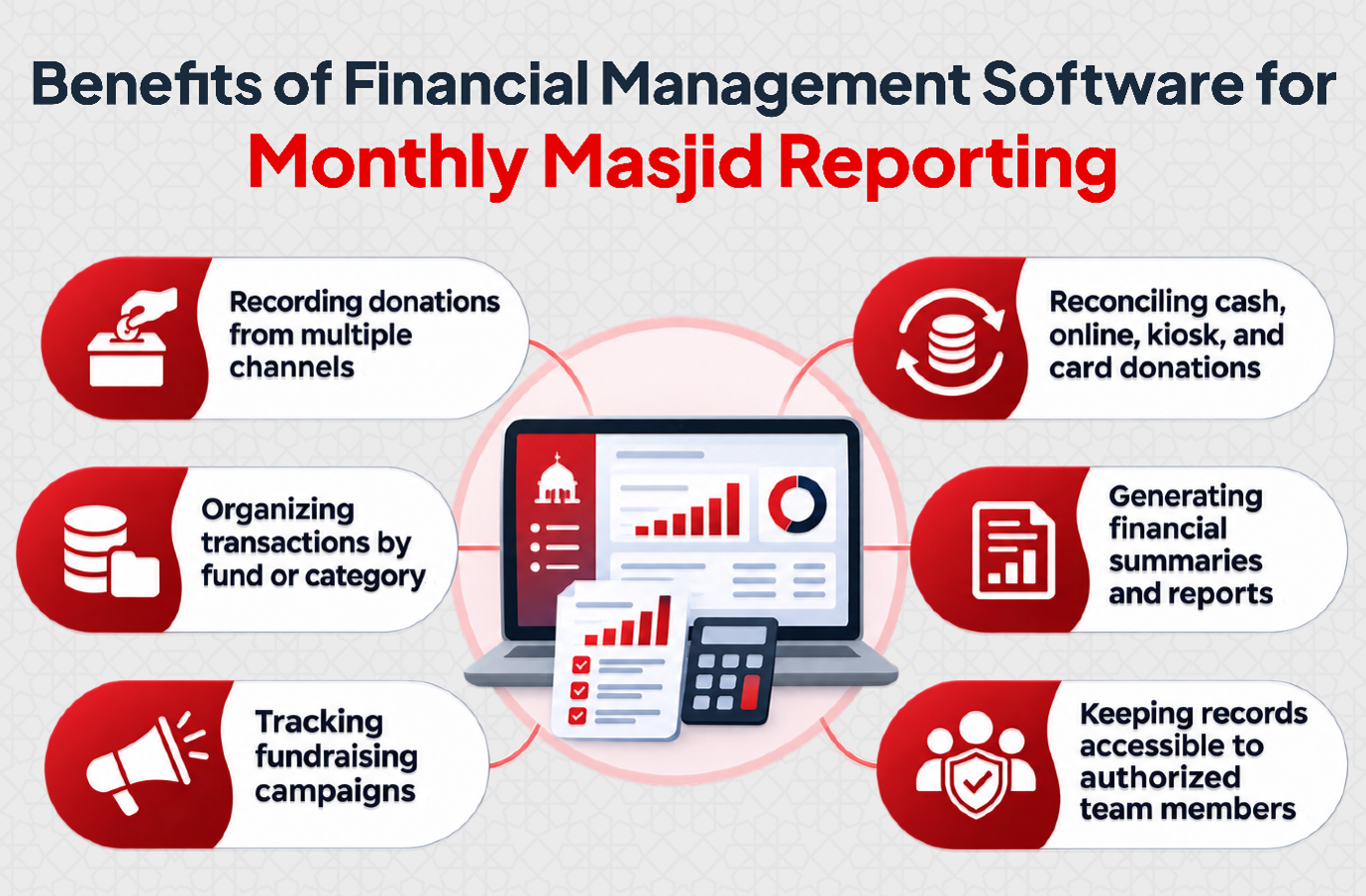
Software supports oversight but does not replace board review, internal controls, or professional accounting advice.
How MOHID Helps Masjids Manage Financial Information
MOHID is a masjid management software that facilitates donation management and administration procedures. MOHID Donation Management integrates donations, membership, and Zakat contributions within a single platform with real-time reporting. MOHID Fundraising Management maintains campaign and donor information.
Online donations, a kiosk, and the tap-to-donate mTAP devices are integrated into the same record, thereby enabling donation reconciliation and giving the board members the ability to maintain well-organized records for review each month.
FAQs About Mosque Financial Reporting
1. What financial reports should a masjid review every month?
Income, expenses, budget versus actual, cash flow, reconciliation, funds, campaigns, bills, payroll, and a summary.
2. Who is responsible for preparing a masjid’s monthly financial reports?
Typically, the treasurer or finance committee prepares the masjid’s financial reports, and the board reviews them.
3. How often should a masjid board review its finances?
The masjid board should review finances monthly, with a more detailed annual review at year-end.
4. What is the difference between a masjid income report and an expense report?
An income report shows money received by source; an expense report shows money spent by category.
5. How should masjids track restricted donations?
Restricted donations are tracked by fund and confirmed that they are spent as intended by the donors.
6. Why is bank reconciliation important for mosques?
Bank reconciliation confirms bank activity matches internal records and catches errors early.
7. Can masjid management software help with financial reporting?
Yes, it centralizes records, but it doesn’t replace board review or professional accounting advice.
Conclusion
Monthly reviews help boards maintain transparency, accountability, and financial control. Reviewing donations, expenses, budgets, cash flow, restricted funds, and outstanding obligations keeps surprises to a minimum.
Use a consistent checklist and document every decision. Good Mosque Financial Reporting is a habit, and the right tools make it easier to sustain. Consider exploring MOHID as a way to organize your masjid’s donation and financial management workflows.
Ready to simplify donation management and financial oversight?
Related Resources
Masjid Donation Reporting: 10 Metrics Every Mosque Should Track