Skip to content


TL; DR – The Short Answer
A Recurring Donation Program helps masjid administrators, fundraising teams, and community leaders encourage consistent monthly giving. Set clear fundraising goals, offer convenient donation options, communicate regularly with donors, and review reports often. Recurring gifts provide more predictable financial support for mosque operations and community programs, making budgeting easier.
Introduction
Mosques require consistent funding to carry out various activities like maintenance, religious programs, and community initiatives. One of the most dependable ways to provide this ongoing funding is to build a recurring donation program, since community members donate regularly rather than only during campaigns.
It is difficult to project funds that depend on seasonal donations and periodic campaigns. The majority of masjids use donation software for nonprofit organizations that provides recurring donations on a convenient schedule.
This makes it easier to secure steady funding, strengthen donor relationships, cover recurring costs, and avoid sporadic campaigns. Here is a detailed guide on how to achieve it.
What Is a Recurring Donation Program?
A recurring donation program lets community members set up regular donations, which are processed automatically on a schedule they choose.
How Does Recurring Giving Work?
Donors authorize regular gifts to the masjid once, and the system processes each contribution automatically on the chosen schedule: daily, monthly, weekly, quarterly, or annually. This means supporters don’t have to remember to give each time, while the masjid benefits from a steady, dependable flow of support.
One-Time Donations vs. Recurring Donations
One-time and recurring donations work quite differently in practice. The comparison below shows how they differ in frequency, predictability, donor commitment, planning, engagement, and administrative effort.
| Factor | One-Time Donations | Recurring Donations |
| Payment Frequency | Once | On a chosen schedule |
| Revenue Predictability | Varies by season | More predictable |
| Donor Commitment | Single donation | Ongoing donations |
| Fundraising Planning | Harder to forecast | Easier to plan |
| Donor Engagement | Tied to appeals | Steady relationship |
| Administrative Work | Separate record for every donation | Reduced once set up |
Both ways of donating are essential, so a recurring program should complement, not replace, one-time giving.
Why Should Your Masjid Start a Recurring Donation Program?
Modest monthly gifts from many members add up. The benefits include:
- More predictable monthly revenue.
- Support for regular operating expenses.
- Consistent funding for community programs.
- Better long-term financial planning.
- Stronger donor relationships.
- Less dependence on seasonal fundraising.
- Easier fundraising goal planning.
- More opportunities to improve donor retention.
Step 1: Set Clear Goals for Your Recurring Donation Program
Donors give confidently when they know the cause behind their donation.
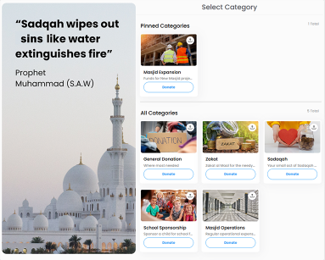
Identify What Your Masjid Needs Funding For
List what donations will cover: daily operations, utilities and maintenance, staff expenses, educational and youth programs, building maintenance and expansion, and general operating funds.
Set Realistic Fundraising Targets
Estimate monthly operating expenses, work out the recurring revenue needed, and set achievable short-term and long-term participation goals.
Explain the Impact of Monthly Giving
Show donors how their regular donations support specific needs of the masjids, as well as keep goals transparent.
Step 2: Create Simple and Flexible Donation Options
Convenience drives participation, so offer choices that fit each donor.
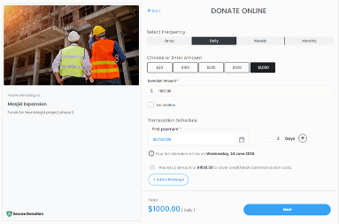
Offer Suggested Donation Amounts
Provide several suggested monthly levels and include a custom amount option.
Provide Flexible Giving Frequencies
Offer monthly, weekly, quarterly, and, where supported, annual giving.
Make It Easy to Start, Update, or Cancel Donations
Explain the process and let donors update, pause, or cancel donations. Simplicity builds confidence.
Flexible giving options help more people say yes.
Step 3: Make Recurring Donations Easy Across Multiple Channels
A Donation software for nonprofits can offer giving across several touchpoints:
- Website donation page: a central home for giving.
- Donation kiosks: in-person giving at the masjid.
- Card payments: a familiar, convenient checkout.
- QR codes: a direct link to the giving page.
- Email campaigns: donation links in every appeal.
- Social media links: an easy path to sign up.
Not every channel supports automatic recurring payments, so explain which ones allow scheduled giving.
Step 4: Promote Your Recurring Donation Program
A Recurring Donation Program grows when the community knows about it, so introduce it through various moments and channels.
Promote During Friday Prayers and Community Gatherings
Introduce the program in announcements, explain why consistent support matters, and share a simple way to donate.
Use Email and Digital Communication
Make separate announcements for your program, including its purpose, target/goal, and the link to your donation page.
Promote During Ramadan and Other Important Periods
Ramadan is a good moment to introduce recurring giving. Encourage donors to continue beyond the season, and avoid making it feel like a one-time appeal.
Use Real Examples to Explain the Impact
Inform people about how the donations contribute to their everyday necessities, and share how close you are to reaching your targets, which will encourage more donations.
Step 5: Build Strong Relationships with Recurring Donors
Recurring giving is an ongoing relationship, not just an automatic payment. Good stewardship includes:
- Sending donation confirmations
- Providing digital receipts
- Sharing regular fundraising updates
- Explaining how contributions are used
- Recognizing donor support appropriately
- Sending important program updates
- Making it easy to contact the masjid
- Respecting donor communication preferences
Step 6: Track Recurring Donations and Monitor Performance
Regular review shows program health and areas needing attention. Key measures include:
- Total recurring revenue: the steady income the program brings in each month.
- Active recurring donors: the number of supporters currently giving on a schedule.
- Average recurring donation: the typical donation amount, useful for setting realistic targets.
- New recurring donors: how quickly participation in the program is growing.
- Recurring donor retention: how long supporters keep giving before they stop.
- Failed or declined payments: donations that did not go through and need prompt follow-up.
- Cancelled recurring donations: cancellations that may point to issues worth investigating.
- Monthly recurring revenue growth: the momentum of the program from one month to the next.
- Donations by campaign or fund: where recurring support is being directed.
- Payment method performance: which payment methods work most reliably for donors.
Is it easy for your donors to start and keep giving?
Evaluate your process today with MOHID.
Common Challenges in Managing Recurring Donations
Most challenges come down to communication, reliability, and records. A few are listed below:
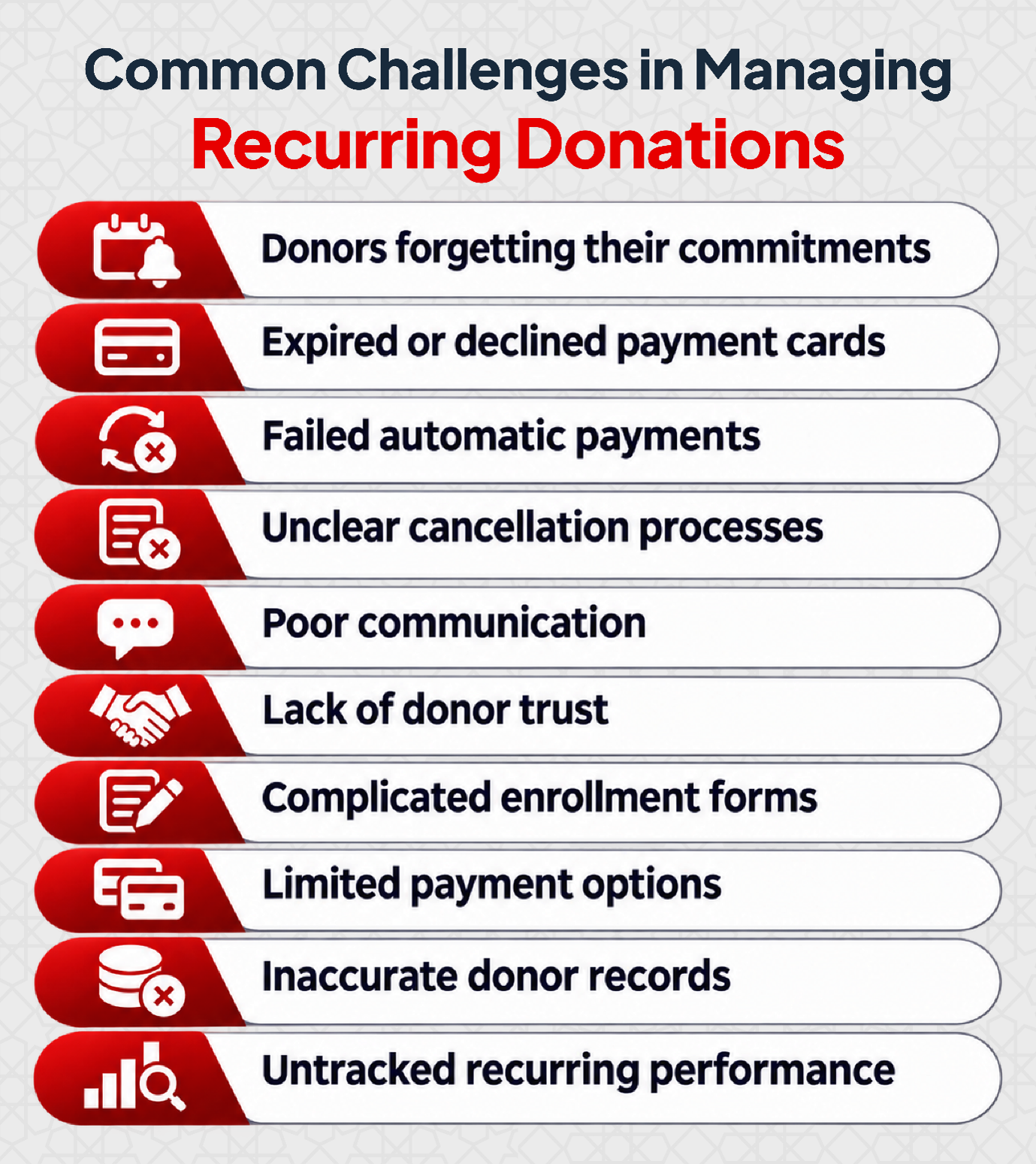
Clear communication, reliable payments, and organized donor records address most of these.
How Technology Helps Manage a Recurring Donation Program
Technology takes the repetitive work out of running a recurring donation program.
Automate Recurring Payments
Supported systems process scheduled donations, send confirmations, and flag failed payments securely, which helps both donors and administrators in the long run.
Centralize Donor Records
Donation management software keeps donor profiles and history together, identifies recurring donors, and tracks gifts by fund or campaign.
Simplify Fundraising Reporting
A management system can show recurring revenue, active donors, payment activity, retention trends, and generate fundraising reports.
How MOHID Can Support Your Masjid’s Recurring Donation Program
Practically, MOHID is a cloud-based solution designed for masjids. Its Donation Management tools consolidate donations, memberships, and Zakat with real-time reporting, while Fundraising Management organizes campaigns.
The giving options MOHID offers range from online donations to kiosk, card payments, and tap-to-donate mTAP devices, along with Announcement Email and SMS for donor communication. The connected donor records make it easier for administrators to track their ongoing support without manual effort.
Frequently Asked Questions
1. What is a Recurring Donation Program?
It is a structured way for members to donate regularly on a chosen schedule, set by them.
2. Why should a masjid accept recurring donations?
Accepting recurring donations creates predictable income and reduces reliance on seasonal campaigns.
3. What is a good monthly donation amount for a masjid?
There is no single right amount; suggested levels plus a custom option fit every budget.
4. How can mosques encourage monthly donations?
Explain what funds support by sharing impact, simplify the donation process, and promote giving at gatherings and by email.
5. Can donors change or cancel recurring donations?
Yes, donors should be able to update, pause, or cancel recurring donations at their convenience.
6. How do recurring donations help with mosque budgeting?
These donations provide predictable revenue, which makes planning around expenses easier for admins.
7. What is the good amount to donate to a masjid every month?
Choosing the donation amount is a personal decision for donors; any sustainable amount helps.
8. How can masjids track recurring donation revenue?
Masjids track recurring revenue by using specialized mosque management and donor software that automatically processes and logs weekly or monthly contributions.
9. How can mosque management software help manage recurring donations?
Management software helps centralize records, support scheduled payments, and generate reports.
Conclusion
A successful Recurring Donation Program takes more than adding a monthly option. It follows six steps: setting fundraising goals, providing multiple giving options, making your payment process easier, promoting your program, nurturing donor relationships, and measuring your success by tracking performance.
Setting clear goals, offering convenient payment methods, communicating transparently, and measuring results consistently will lead to success, and donation software for nonprofits eases tracking.
Recurring donations make planning more predictable, while donation management software keeps details organized. Begin with a clear fundraising goal and a simple donation process.
Ready to make monthly giving easier?
Start with one clear goal and one simple sign-up.
Related Resources
Donor Retention Strategies: How to Turn One-Time Donors into Regular Supporters
How to Automate Donations for the Blessed 10 Days of Dhul Hijjah