Skip to content


TL; DR – The Short Answer
A CRM for Fundraising helps masjid management, fundraising teams, and board of directors to organize donor database, manage campaigns, donations tracking, track pledges and repeat donors. Spreadsheets get complicated to work with, as the number of donors grow which causes duplication and outdated information.
Introduction
Masajid rely on fundraising to support their operations, fundraising activities, construction projects, Ramadan campaigns, and other initiatives. But the information about the donors becomes fragmented and spread out across different sheets, payment platforms, email messages, and papers. Using a CRM for Fundraising brings all that information together and allows the administration to understand all the relationships with donors.
This practical guide shows how to choose and use a CRM for masjid fundraising and how it helps masajid manage donor information, campaigns, recurring donations and pledges, segment donors, and enhance reports.
What is a Masjid CRM?
CRM stands for customer relationship management, which is essentially an organizational system for managing the relationship between the organization and its supporters and constituents. CRM is different from a list because it holds onto the story of why each gift was made.
What Does CRM Mean for a Masjid?
A Masjid CRM transforms administrative operations by replacing spreadsheet lists with a centralized relationship engine that links every community member’s personal profile, giving history, and event attendance into a single, cohesive database. Unlike traditional bookkeeping that only tracks transactional data like dates and dollar amounts, a CRM captures vital information, such as volunteer hours, family relationships, and preferred fundraising campaigns (like Zakat or building funds).
Maintaining this complete institutional memory prevents donor relationships from being lost during leadership rotations, safeguards personal data, and allows administrators to move toward personalized engagement that deepens community trust.
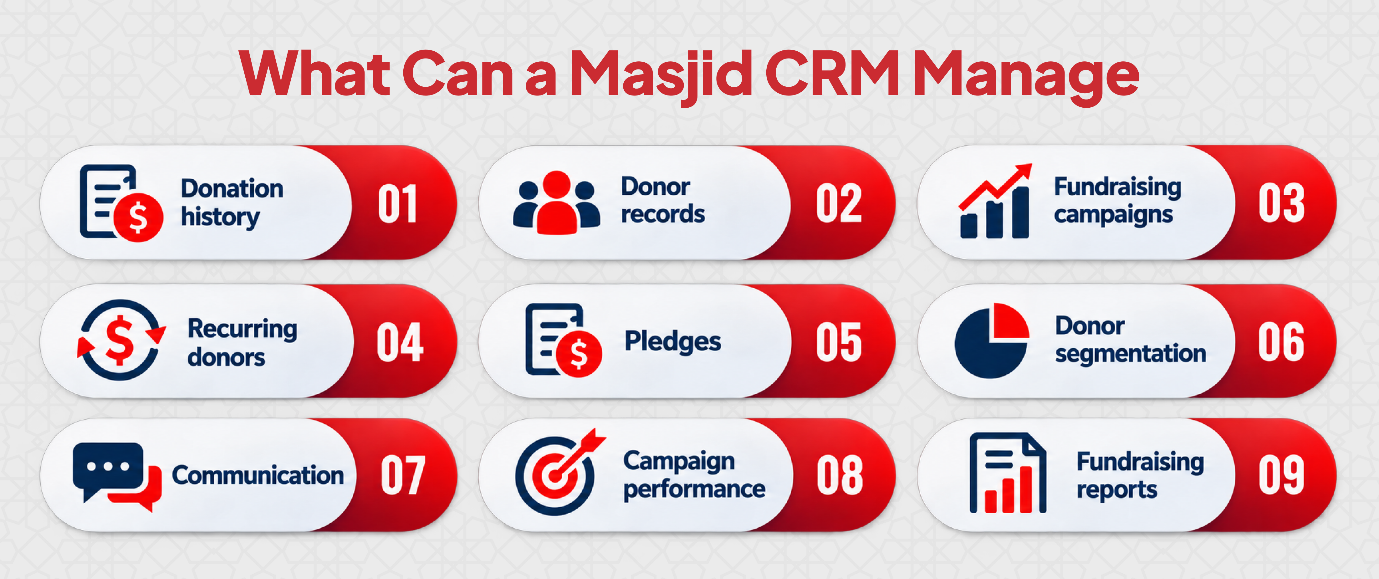
What Can a Masjid CRM Manage?
A CRM or Mosque management system centralizes the administrative, financial and community-financial engagement of an Islamic centre or masjid.
Why Spreadsheets Fail for Fundraising as Your Masjid Grows
Spreadsheets are great for simple recordkeeping, and they’re not inherently a bad choice, but they tend to get inefficient as fundraising scales, while a CRM for Fundraising is designed to manage the increasing numbers. The most common reasons why spreadsheets fail to cope with the growing needs of large-scale Islamic organizations include:
- Duplicate donor records appear when the same donor is entered more than once.
- Manual data entry consumes time and increases the chance of errors.
- Donor history becomes scattered and difficult to review in one place.
- Campaign visibility stays limited, making progress hard to gauge.
- Pledges are tracked manually, which makes follow-ups easy to miss.
- Recurring donors are difficult to monitor consistently.
- Reporting is slow and takes real effort to assemble.
- Multiple people editing separate copies leads to conflicting files.
- Information quickly becomes outdated if not updated regularly.
- Automation is minimal, leaving repetitive tasks to staff and volunteers.
How a Masjid CRM Helps Manage Donor Records
A fundraising CRM replaces scattered paper lists and spreadsheets with a centralized digital platform to track, organize, and grow donor support.
Create Centralized Donor Profiles
The profile should consist of donor contact details, donation history, campaign participation records, and interaction notes for each individual donor.
Build a Complete Donor History
Administrators see previous donations, campaigns, recurring giving, pledges, and communication history together, helping teams understand relationships over time.
Use a CRM to Track Fundraising Campaigns
Create and Organize Campaigns
Use CRM to manage Ramadan drives, masjid expansion and construction campaigns, Zakat, operational funds, emergency campaigns, and community campaigns; each can be conducted independently.
Monitor Campaign Progress
- The fundraising goal is compared against the amount raised so far, showing how close the campaign is to its target.
- The number of donors and the average donation show how broadly and how generously the community is giving.
- Overall campaign progress is visible at a glance, so teams know when to push donors or adjust their approach.
- Outstanding pledges are listed clearly, making it easy to see which commitments still need follow-up.
- Recurring contributions are tracked alongside one-time gifts, giving a clearer view of steady, predictable support.
Manage Recurring Donors & Pledges
Recurring Donor Management
Identify recurring donors, review contribution history, and monitor active commitments. Recurring giving supports predictable fundraising revenue.
Pledge Tracking
Register pledges, track pledged amounts, check payments, identify outstanding pledges, and take appropriate action. Linking pledges and recurring gifts to a donor’s overall history keeps the full picture in one record.
Use Donor Segmentation to Improve Fundraising
Segmentation means grouping donors by shared traits, because treating all donors the same doesn’t work, a first-time giver and a long-term supporter expect different conversations. A CRM for Fundraising makes useful groups easy to build:
- First-time donors: new givers that benefit from a warm welcome and thank-you.
- Recurring supporters: steady contributors whose ongoing commitment deserves regular appreciation.
- Major donors: high-value givers who warrant more personal, one-on-one attention.
- Past donors: people who have given before and can be invited back for new campaigns.
- Campaign-specific donors: supporters tied to one cause, such as Ramadan or construction.
- Event donors: people who gave at a fundraising dinner or program and can be re-engaged afterwards.
- Lapsed donors: former givers who have gone quiet and may respond to a gentle reminder.
- Frequency-based groups: donors grouped by how often or how much they give.
Segments let masajid send relevant messages instead of one generic appeal.
Fundraising Reporting: What Should a Masjid Track?
Reporting shows leaders which campaigns and strategies work. A Fundraising CRM ties those numbers directly to donor records. Consistent reporting starts with knowing which numbers matter most, so masajid should keep track of the following parameters:
- Total funds raised
- Campaign performance
- Donor count
- New versus returning donors
- Recurring donations
- Average donation
- Pledged and outstanding amounts
- Donor retention
CRM vs. Donation Software: What’s the Difference?
Most Masjid owners assume a tool that accepts online donations already does everything a donor system would do. However, the two serve different purposes, and the table below compares them across the areas that matter most to fundraising teams.
| Area | CRM for Fundraising | Donation Software |
| Donor Profiles | Complete Profiles | Basic Details |
| Donation Processing | Often connected to a payment tool | Core strength of the software |
| Donation History | Relationship based | Individual transaction records |
| Campaign Management | Yes | Varies |
| Recurring Donors | Tracked with history | Mainly handles recurring payments |
| Pledge Tracking | Tracks Pledges & unpaid amounts | Varies by product |
| Donor Segmentation | Groups donors for targeted out-reach | Usually limited |
| Communication | Supports donor engagement | Usually limited |
| Relationship History | Central purpose of the system | Not the focus |
| Fundraising Reporting | Insights on donors & campaigns | Works at transaction level |
Donation software focuses on processing and recording gifts, while a CRM manages donor relationships, history, engagement, and fundraising activity. Some modern platforms combine both. Neither is universally better; the right choice depends on your masjid’s needs.
Does your process show donors, campaigns, pledges, and recurring giving in full?
Evaluate your process with MOHID.
What to Look for in Masjid CRM Software
Before choosing Fundraising Management Software, compare it with the features provided in the checklist below:
| Feature | Why It Matters for Masajid |
| Donor Management | Centralizes donor information and history |
| Donation History | Shows previous giving activity |
| Campaign Management | Helps organize and monitor campaigns |
| Recurring Donor Tracking | Helps manage ongoing contributions |
| Pledge Management | Tracks commitments and outstanding amounts |
| Donor Segmentation | Enables more relevant communication |
| Communication Tools | Supports donor engagement |
| Fundraising Reports | Provides campaign and donor insights |
| Payment Integration | Connects donations with donor records |
| Automation | Reduces repetitive administrative work |
| Security | Protects donor information |
| User Permissions | Controls staff and volunteer access |
| Scalability | Supports growing fundraising operations |
How MOHID Can Support Masjid Fundraising & Donor Management
MOHID is a cloud-based platform built for masajid. Its Donation Management tools consolidate donations, memberships, and Zakat contributions, with real-time reporting, duplicate elimination, and automated year-end tax summaries.
Fundraising Management covers campaigns and pledge follow-ups with automated reminders, while recurring giving and online payments flow into the same records, giving administrators better visibility.
Frequently Asked Questions
1. What is a CRM for fundraising?
It is a system that centralizes donor relationships, giving history, and campaigns into one dashboard for easy donation and donor management.
2. What is a Masjid CRM?
CRM stands for customer relationship management, and when built around masjid donors, members, and fundraising, it functions as a masjid CRM.
3. Why should a masjid use a CRM instead of a spreadsheet?
Using a CRM helps reduce duplicates, manual entry, and outdated records in the system.
4. What should a Masjid CRM track?
Some of the parameters a Masjid CRM helps track include: donors, gifts, campaigns, pledges, communication, and reports.
5. Can a CRM track recurring donors?
Yes, a CRM does track recurring donors along with their contribution history.
6. Can a CRM manage fundraising pledges?
Yes, A Masjid CRM can manage fundraising pledges as well as payments and outstanding amounts.
7. What is the difference between CRM and donation software?
The main difference to be highlighted is that donation software processes gifts (donations), while a CRM manages donor relationships.
8. How can donor segmentation improve mosque fundraising?
Donor segmentation is dividing donors into specific categories based on their donation habits, which enables relevant messages to those groups.
9. What features should masajid look for in CRM software?
The few major features to look for in CRM software are: donor management, campaigns, pledges, reporting, security, and scalability.
Conclusion
Masjid fundraising takes more than just donation processing; it requires a combination of donor database centralization, campaign tracking, repeat donors, pledges, segmentation, and reporting. Fundraising CRM software helps masajid transition from scattered information to an efficient relationship-focused process.
Selecting an appropriate Fundraising CRM software helps minimize manual processes and allows the team to concentrate on building donor trust. When selecting Fundraising Management Software, analyze your process to see where manual processes hamper donor management, so those areas can be focused on.
If you’re still unsure which features your masjid actually needs.
Get personalized recommendation for your masjid.
Related Resources