Skip to content
TL;DR – The Short Answer
Peer to Peer Fundraising turns donors into advocates who raise funds on your mosque’s behalf through their own networks. For mosques and Islamic organizations, it means wider reach, deeper trust, and stronger giving during Ramadan, masjid construction, and Sadaqah drives. This guide covers how it works, best practices, and the right platform to power it.
Introduction
Every mosque relies on the generosity of its community, but reaching new donors beyond existing members has always been a challenge. This is where Peer to Peer Fundraising changes the game. Instead of a single institution asking for donations, supporters become personal fundraisers, sharing campaigns with their own family, friends, and co-workers.
For mosques and Islamic organizations, this approach is becoming essential as communities grow more digitally connected and donors expect giving to be simple, transparent, and mobile-friendly. The right fundraising management software makes this shift possible by giving every volunteer fundraiser their own page, tools, and tracking dashboard.
The benefits are substantial: broader donor networks, higher trust because asks come from familiar faces, and lower cost per dollar raised compared to traditional appeals.
In this complete guide, readers will learn what this fundraising model is, how it works specifically for mosques, the best practices that drive results, and how to choose a platform built for Islamic giving.
Understanding Peer to Peer Fundraising
What Does It Mean, Exactly?
This fundraising model is a giving approach where an organization’s supporters create their own personal or team fundraising pages to collect donations on the organization’s behalf. Rather than donors giving directly to the mosque alone, they give through a volunteer’s page, turning every congregant into a potential ambassador.
How the Model Works
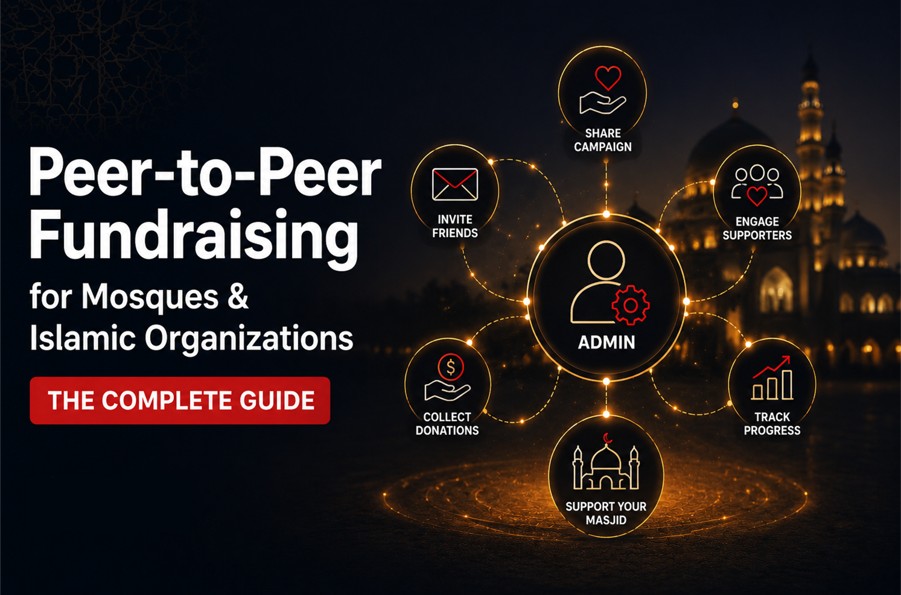
A mosque sets up a central campaign, then invites volunteers, youth groups, or board members to register as individual fundraisers. Each fundraiser receives a customizable page with a personal goal, story, and shareable link. As they reach out to their own circles, donations flow back into the mosque’s main campaign total.
How It Differs from Traditional Fundraising
Traditional fundraising typically relies on the mosque directly soliciting its known donor base through khutbahs, newsletters, or mailers. This peer-driven model multiplies that reach exponentially, since every participant brings an entirely new circle of potential donors who may never have heard of the mosque otherwise.
Common Types of P2P Fundraising Campaigns
- Ramadan fundraising campaigns: The most active giving season for Muslim communities
- Masjid construction and expansion campaigns: Large capital projects that benefit from community-wide participation
- Sadaqah and Zakat fundraising: Ongoing charitable giving tied to Islamic obligations
- Youth and community program fundraising: Funding for education, sports, and outreach initiatives
- Emergency relief and humanitarian fundraising: Rapid-response campaigns for crises at home or abroad
Want a head start on your next fundraising appeal?
See how MOHID can set your campaign up for success from the very first day.
Benefits of Peer-to-Peer Giving for Mosques & Islamic Organizations
Mosques that adopt this model consistently see measurable advantages:
- Expands donor reach through each supporter’s personal network of friends, co-workers, and family
- Increases community engagement, since congregants feel personally invested in the mosque’s mission
- Builds stronger relationships between the mosque and both new and existing donors
- Encourages recurring donations, turning one-time gifts into ongoing monthly support
- Reduces fundraising costs while dramatically increasing campaign visibility online
- Makes fundraising more personal and trustworthy, since asks come from someone the donor already knows
How This Fundraising Model Works for Mosques
Creating a Fundraising Campaign
Start with a clear cause; Ramadan giving, a new prayer hall, or Zakat distribution and set an overall goal that volunteers can rally behind.
Empowering Volunteers and Supporters as Fundraisers
Invite active congregants, youth leaders, and board members to register as fundraisers, each with their own page and story to share.
Setting Individual and Team Fundraising Goals
Individual and team targets add friendly structure, helping fundraisers track their progress and stay motivated throughout the campaign.
Sharing Campaigns Through Social Media, Email, and Messaging Apps
Fundraisers spread their pages through WhatsApp groups, Facebook, Instagram, and email lists, extending the mosque’s message far beyond its usual audience.
Tracking Progress and Recognizing Top Fundraisers
Live leaderboards and progress trackers keep momentum high, while public recognition motivates fundraisers to keep pushing toward their goals.
Best Practices for a Successful Peer-to-Peer Campaign
- Set clear, specific fundraising goals from day one
- Create a compelling campaign story rooted in real community need
- Use high-quality images and videos to bring the cause to life
- Make donation pages simple and mobile-friendly for quick giving
- Equip fundraisers with ready-to-use marketing materials like graphics and sample posts
- Encourage friendly competition with visible leaderboards
- Send regular campaign updates to keep donors and fundraisers engaged
- Thank and recognize donors and fundraisers publicly and promptly
Choosing the Right Fundraising Platform
Essential Features to Look For
A dependable platform should offer custom fundraising pages, a mobile-friendly donation experience, secure online payment processing, recurring donation support, team fundraising capabilities, campaign analytics and reporting, social media integration, and CRM and donor management integration. Since Islamic giving includes distinct categories like Zakat and Sadaqah, a general-purpose virtual fundraising software built for secular non-profits often falls short of a mosque’s actual needs.
Curious what your mosque’s dashboard could look like?
See the benefits in action for your own community
Questions to Ask Before Selecting a Platform
Before committing to a platform, mosque leadership should get clear answers to a few key questions:
- Does the platform understand Islamic donation categories like Zakat & Sadaqah?
- Does it support live goal-tracking widgets to display progress in real time?
- Can it be integrated with mobile card readers and donation kiosks?
- Does the platform offer responsive support during high-traffic seasons like Ramadan?
MOHID was purpose-built to answer yes to each of these, combining donation kiosks, a branded mobile app, QR code giving, and virtual fundraisers with real-time goal trackers into one unified dashboard.
Common Challenges and How to Overcome Them
| Challenge | Solution |
| Limited volunteer participation | Recruit fundraisers early, before the campaign officially launches, and keep the sign-up process to just a couple of clicks so busy congregants don’t drop off. |
| Low campaign visibility | Equip every fundraiser with shareable social media graphics and place QR codes on flyers, posters, and prayer hall screens so donating is always one scan away. |
| Donor fatigue | Space major campaigns throughout the year and rotate the stories and causes highlighted, so the same donors aren’t asked the same way too often. |
| Managing multiple fundraising teams | Run every team and individual fundraiser through one centralized dashboard, so leadership can track totals, goals, and top performers without juggling spreadsheets. |
| Keeping supporters engaged | Send short, timely progress updates and publicly celebrate milestones, so fundraisers and donors both feel connected to the campaign’s momentum. |
| Measuring campaign success | Rely on built-in analytics and reporting instead of manual tracking, so results, trends, and donor activities are visible in real time. |
Measuring the Success of Your Campaign
Key Metrics to Track
- Total funds raised
- Number of donors
- Average donation amount
- Number of active fundraisers
- Social media shares and engagement
- Recurring donor growth
- Campaign conversion rate
Using Campaign Insights to Improve Future Fundraising
Reviewing these metrics after every campaign reveals what resonated with donors and what needs adjusting. Mosques that consistently analyze their results tend to see steady growth from one campaign to the next, refining their story, timing, and outreach channels along the way.
Frequently Asked Questions
1. What is peer-to-peer fundraising?
It is a fundraising approach where individual supporters create their own pages to raise donations on behalf of an organization, expanding reach well beyond the organization’s direct audience.
2. How does this fundraising model work?
Volunteers register as fundraisers, receive a personalized page and shareable link, then invite their own networks to donate toward the mosque’s overall campaign goal.
3. Why is this approach effective for mosques?
Because asks come from trusted community members rather than the institution alone, donors are more likely to give and to give generously.
4. What features should a fundraising platform have?
Look for custom pages, mobile-friendly giving, secure payments, recurring donation support, analytics, and CRM integration tailored to Islamic giving categories.
5. Can this model be used for Ramadan, Zakat, and Sadaqah campaigns?
Yes. These are among the most common and successful use cases, since giving increases naturally during these periods.
6. How do you motivate supporters to become fundraisers?
Make it easy to sign up, provide ready-made materials, celebrate top performers publicly, and clearly communicate the impact of every dollar raised.
Conclusion
Peer to peer fundraising gives mosques and Islamic organizations a powerful way to grow donations while deepening community engagement at the same time. By turning supporters into advocates, campaigns reach further, feel more personal, and build lasting relationships with donors. As digital giving continues to grow, adopting this model as part of a long-term fundraising strategy is one of the smartest moves a mosque can make.
If your mosque is ready to grow its giving community, explore MOHID; a complete fundraising management software built for peer-to-peer campaigns, donor management, Zakat tracking, and secure online giving.
Experience how a modern giving platform can transform your next fundraising campaign.
Related Sources:
How to Write Fundraising Appeal Letters: Tips, Examples, and Templates
Top Online & Offline Fundraising Ideas for Non-profit Organizations That Actually Work
Best Virtual Fundraising Ideas for Masjids in 2025