Skip to content


TL; DR – The Short Answer
Masajid can reconcile donations across cash, online, kiosk, and card channels by recording every gift, matching transactions with bank and processor statements, categorizing funds, verifying donation details, generating reports, and maintaining a complete audit trail.
Introduction
Accurate donation records are the foundation of a reliable masjid, and the key to the discipline of reconciling donations is to make sure they are consistent. It means matching collected donations with recorded transactions and financial records.
Donations do not come through one single door: Cash is received at Jummah prayers; online donations come in through websites and mobile applications, and card contributions are collected during events. Another source of donations is the Donation Kiosk in the lobby. Processing all these sources separately will result in different figures and missed transactions.
This guide covers a seven-step process:
Collect → Record → Reconcile → Categorize → Verify → Report → Audit.
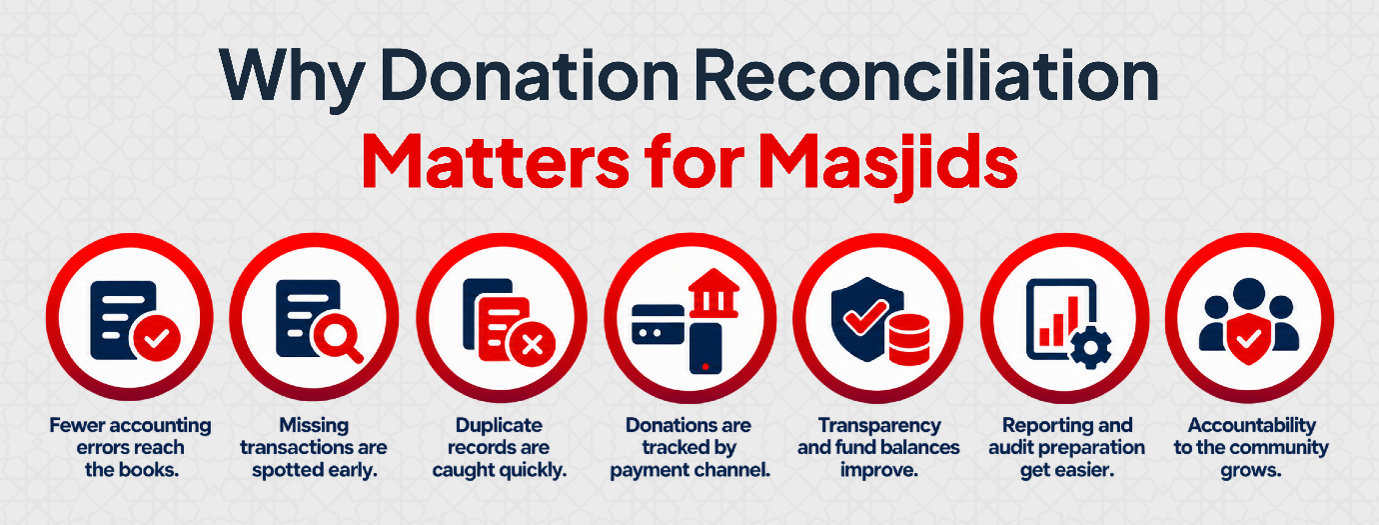
Why Donation Reconciliation Matters for Masajid
Accurate donation records protect the community’s trust and the masjid’s finances. Consistent reconciliation delivers several practical benefits:
Step 1: Collect Donations from Every Channel
Reconciliation begins by identifying every source of giving, which normally includes:
- Cash donations collected at the masjid
- Gifts received through the website or mobile app
- Transactions made with a donation kiosk
- Card payments accepted through tap-to-pay technology
- Using cheques, where applicable
- Setting up online recurring donations
Each channel can produce different records, receipts, settlement times, and fees.
Step 2: Record Every Donation Accurately
Reliable reconciliation depends on recording every gift promptly and consistently, whatever the channel.
Record Cash Donations
Count your cash according to set protocols, record the amount and the date, have proper documentation, and ensure that another person checks the process where necessary.
Record Online, Kiosk & Card Donations
Record all transaction details and payment references, including gross figures and the fees. Whether the donation is made via a Donation Kiosk or a card reader, match it to the right donor or campaign.
Maintain a Centralized Donation Record
Combining all data from different channels into one system will make the process easier, as the transactions can easily be traced and compared.
Step 3: Reconcile Donations Against Financial Records
To Reconcile Donations properly, compare your records with what is actually received.
Compare Donation Records with Bank Transactions
Match recorded online donations and other gifts with bank deposits and settlements, allow for timing differences, and flag anything unmatched.
Reconcile Each Payment Channel
Compare each channel with its own source record:
- Cash counted versus cash deposited at the bank
- Web and app gifts versus payment processor records
- Kiosk transactions versus kiosk reports
- Card payments versus card processor settlements
Investigate Differences
Common causes include processing fees, refunds, failed transactions, chargebacks, timing differences, duplicate entries, and data-entry mistakes.
Simplify donation reconciliation across every payment channel.
Step 4: Categorize Donations Correctly
Assigning each gift to the right fund, campaign, or purpose shows exactly how much was received for each need.
- General donations: everyday gifts that support the masjid’s regular operations.
- Zakat: obligatory giving that must be tracked and distributed separately.
- Sadaqah: voluntary charity recorded on its own, so its use stays clear.
- Ramadan campaigns: seasonal gifts collected for iftars and other Ramadan programs.
- Masjid construction: contributions dedicated to building projects.
- Expansion projects: funds raised to grow or renovate existing facilities.
- Emergency funds: gifts set aside for urgent relief and unexpected needs.
- Specific fundraising campaigns: donations tied to a named appeal with its own goal.
- Restricted funds: money donors have designated for a particular purpose.
- Unrestricted funds: flexible money the masjid can use wherever it is needed most.
Step 5: Verify Donation Records
Verification confirms that what was recorded is correct, complete, and properly assigned.
Verify Transaction Amounts
Confirm recorded amounts match source records, check deposits and settlements, and review any unusual differences.
Verify Donor and Campaign Information
Confirm that each donation is linked to the correct donor, verify campaign and fund assignments, and check for duplicates.
Establish Internal Checks
Use clear approvals, limit access to sensitive financial data, document adjustments, and separate collection, recording, and verification duties where practical.
Step 6: Report Donation Activity
Reconciled data produces accurate financial and fundraising reports covering:
- Total donations: the overall amount received across all channels in each period.
- Donations by payment method: show which channels the community uses most.
- Donations by campaign: reveal how each appeal is performing against its goal.
- Donations by fund: keep balances clear for Zakat, Sadaqah, general, and restricted funds.
- Cash collected: confirms the amount counted matches what was recorded and deposited.
- Web and app gifts: track digital giving alongside processor records.
- Kiosk gifts: summarize transactions made at the masjid’s kiosk.
- Card payments: accounts for card transactions and settlements.
- Processing fees: separates the cost of accepting gifts from the amount donated.
- Refunds and chargebacks: records of money returned so net totals stay accurate.
- Outstanding reconciliation items: list unmatched entries that still need investigation.
These reports give leaders a clearer picture of fundraising performance and available funds.
Step 7: Prepare Donations for Audit & Review
A clear audit trail and a steady review schedule make audits far less stressful.
Maintain a Clear Audit Trail
Keep transaction records, deposit documentation, processor reports, adjustment notes, and relevant receipts.
Review Reconciliation Regularly
High-volume operations may review daily, others weekly or monthly, with extra reviews before reporting or audits.
Resolve Outstanding Differences
Investigate and document unresolved items instead of adjusting them without explanation.
Get audit-ready records without the scramble.
How Technology Can Simplify Donation Reconciliation
Manual reconciliation works for a small masjid with a single collection box, but it strains quickly as giving moves across more channels; the right tools remove much of the manual effort from each step.
Centralize Donation Data
Software built to Reconcile Donations brings cash, online, kiosk, and card data into one workflow. Instead of piecing together paper counts, processor reports, and separate spreadsheets, administrators can review every gift side by side, trace any transaction back to its source, and spot gaps long before a board meeting or audit.
Automate Repetitive Tasks
Automation can take over the routine work that consumes the most volunteer and staff hours:
- Recording and categorizing transactions
- Tracking payments
- Generating receipts
- Producing campaign reports
- Updating donor records
- Preparing reconciliation reports
Connect Donations with Fundraising & Donor Management
Linking transactions to donor records and campaigns reduces duplicate work, since a single entry updates the donor’s history, the campaign total, and the fund balance together. It also gives finance teams one shared, reliable picture, so questions about how a campaign is performing can be answered quickly and with confidence.
How MOHID Can Help Masajid Manage Donations
As a practical example, MOHID is a cloud-based platform built for masajid. Its Donation Management tools keep donations from different channels in one system, with real-time reporting and automated year-end tax summaries.
Giving options include online giving, a kiosk, and the tap-to-donate mTAP device, while Fundraising Management and Zakat Management tie campaigns and funds to the same records, helping finance teams review activity.
Common Donation Reconciliation Mistakes to Avoid
A few common slips make it harder to Reconcile Donations accurately:
- Recording donations late
- Skipping reconciliation across payment channels
- Mixing restricted and unrestricted funds
- Ignoring processing fees
- Overlooking refunds and chargebacks
- Creating duplicate records
- Leaving adjustments undocumented
- Not reviewing cash deposits
- Relying entirely on spreadsheets
- Delaying reconciliation too long
- Skipping the audit trail
Frequently Asked Questions
1. What does it mean to reconcile donations?
Donation reconciliation means comparing recorded donations with actual cash, bank deposits, and payment processor records to ensure every contribution is accounted for.
2. How do you reconcile cash donations?
Count collected cash, compare it with donation records, verify bank deposits, and investigate any discrepancies. MOHID helps organize donation records for easier tracking.
3. How do you reconcile online donations?
Compare online donation records with payment processor statements and bank deposits, accounting for fees, refunds, and failed payments. MOHID helps track online donations and generate transaction reports.
4. How do you reconcile kiosk donations?
Review kiosk transactions, verify successful payments, and compare settlement reports with bank deposits. MOHID helps masajid track digital donations through its donation management tools.
5. How do you reconcile card payments?
Compare card transactions with processor settlement reports and bank deposits, accounting for fees, refunds, and declined payments. MOHID helps organize card payment records for review.
6. How often should a masjid reconcile donations?
Masajid should ideally reconcile donations daily or after major fundraising events, followed by a monthly review to maintain accurate financial records.
7. What should be included in a donation reconciliation report?
Include donation dates, amounts, payment methods, transaction statuses, donation categories, processing fees, refunds, bank deposits, and any discrepancies.
8. Why is donation reconciliation important for mosques?
It promotes financial transparency, protects donated funds, identifies errors, and helps ensure donations are allocated according to their intended purposes.
9. Can mosque management software help reconcile donations?
Yes. MOHID provides donation management and reporting tools that help masajid track contributions across different channels, organize transaction records, and simplify financial reviews.
Conclusion
Collect, record, reconcile, categorize, verify, report, and audit. Following these steps consistently helps masajid maintain accurate donation records, strengthen financial transparency, and ensure accountability.
Managing donations across multiple channels becomes easier when all transaction data is centralized, including cash, online donations, and card payments. Donation kiosks can also be integrated into this workflow for more efficient tracking and reconciliation.
With a consistent process and tools like MOHID, mosque finance teams can reduce manual work, simplify donation management, and maintain reliable financial records.
Track Zakat, Sadaqah, and campaign funds separately.
See how MOHID simplifies fund reporting.
Related Resources