Skip to content

TL;DR – The Short Answer
Financial Management for Nonprofit Organizations involves proper budgeting, financial recordkeeping, enforcing internal controls, and proper financial reporting, all while using the right technology. Together, these practices protect resources and ensure sustainable growth from year to year.
Introduction
Purpose-driven organizations run on two things: purpose and money. A food bank, a scholarship fund, and any community Masjid can be driven by the most noble vision, but the lack of proper financial management will leave that vision lifeless. The board of directors starts worrying, donor questions become more complicated, and employees start spending more time dealing with numbers rather than people.
Non-profit organizations need to find the right balance between impact and financial management. It is important to be passionate about the program, but knowing the source of every single donation and its destination equally matters. Proper budgeting, financial controls, accounting, and transparency are not extra steps; they are the main pillars allowing an organization to fulfil all obligations in front of donors, beneficiaries, and regulatory agencies.
In the sections ahead, we will talk about what strong financial management actually looks like, why it matters, the best practices worth adopting, long-term sustainability strategies, and the software tools, including purpose-built platforms for religious and community organizations, that make all of it easier to manage.
What Is Financial Management for Nonprofit Organizations?
In simple words, it is the process through which management controls, budgets, tracks and reports all monetary inflows and outflows so that it meets its organizational objectives. It starts with budget preparation in the month of January and goes up to the preparation of audited financial statements by year-end.
The fundamental distinction from commercial organizations is in their objectives. While a commercial business measures success in profit, a non-profit organization measures success in impact, while still needing enough revenue to keep operating. Every dollar donated by an individual, every grant received from a foundation, and every membership fee is usually accompanied by some conditions or restrictions attached to it.
Key responsibilities typically include:
- Budgeting and forecasting
- Managing donations and grants
- Tracking expenses
- Cash-flow management
- Financial reporting
- Compliance and audits
- Financial transparency
Why Financial Management Matters for Non-profits
Good money management not only ensures balance; it also guarantees the financial stability of the organization in case of hard times or any emergency. When decision makers have access to clear and up-to-date figures, they will base their decisions on facts, not assumptions, whether it is a matter of implementing a new project or holding off on non-mandatory expenses.
Donors and foundations also pay close attention to how well the contributions are managed. When you show your supporters that their funds are being managed according to the intended purposes, then there will be mutual trust, which will lead to future contributions and increased donations.
Poor money management practices increase the risks of financial mistakes and fraud, consequences that can quietly erode years of hard work. Strong stewardship paired with consistent reporting supports long-term growth for the organization.
Ready to see how a purpose-built platform could simplify your finances?
Key Components of Effective Non-profit Financial Management
Budgeting and Financial Planning
Creating an annual operating budget is the starting point for every other financial decision. It is imperative that non-profits develop a realistic budget using past data and not just being optimistic about future possibilities. The process should involve distinguishing between restricted and unrestricted funds from the very beginning. Budgeting shouldn’t be a one-time deal; budgets should be reviewed and updated regularly depending on changing fundraising figures and program costs.
Cash Flow Management
Cash flow management provides information about the organization’s finances in real time that a budget cannot do. It is important for organizations to keep track of their income from donations, grants, etc., along with their expenses in order to have enough cash reserves on hand to pay salaries, utilities, and cover program costs. Having enough cash reserves and considering the seasonal changes in fundraising are critical tasks.
Expense Management
Spending guidelines avoid misunderstandings and minimize risks. It entails developing spending policies, correctly classifying expenses, and setting approval limits. Organizational leaders must track administrative costs and program expenses independently, as donors and watchdogs usually look at how much of every dollar gets directly to the cause.
Fund & Donation Management
Documentation of all donations is mandatory. Non-profits should track all contributions, record any restricted funds and reconcile all contributions to bank accounts on an ongoing basis. Giving appropriate documentation and records is not only a recommendation but also a necessity because in many cases it is required by law.
Financial Reporting
Data is useless if it cannot be seen. Organizations need to compile financial statements regularly, report income and expenses in a consistent way, and provide financial reports to organizational leaders and the board which include not only raw numbers but also some analysis based on those numbers. Financial data helps evaluate organizational performance.
Best Practices for Non-profit Financial Management
Separate Restricted and Unrestricted Funds
Restricted funds come with donor-imposed conditions; say, a grant earmarked only for a youth program, while unrestricted funds can be used wherever the organization needs them most. Accurate fund allocation matters because mixing the two, even unintentionally, can breach donor agreements and damage credibility. Clear coding and dedicated tracking help avoid using restricted funds for unrelated expenses.
Establish Strong Internal Financial Controls
Internal controls are the guardrails that keep money moving safely through an organization. This starts with defining financial responsibilities clearly, so everyone knows who approves what. Using approval and authorization processes, separating financial duties where possible, and maintaining proper documentation together create a system where no single mistake can go unnoticed for long.
Reconcile Accounts Regularly
Reconciliation is the habit of comparing accounting records with bank statements to confirm everything matches. Doing this consistently helps identify errors or unusual transactions quickly, before small discrepancies grow into bigger problems. Establishing a consistent reconciliation schedule, whether weekly or monthly, keeps the books trustworthy.
Maintain Accurate Financial Records
Good recordkeeping means more than avoiding a shoebox of receipts. Organizations should keep receipts, invoices, donation records, and financial statements organized and easy to retrieve. Establishing document retention policies and using centralized digital records where appropriate makes audits, grant reports, and board reviews far less stressful.
Review Financial Performance Regularly
A budget set in January can look very different by June. Monthly or quarterly financial reviews let leadership compare actual performance against the budget, identify financial risks early, and adjust spending and fundraising strategies when necessary, before a shortfall becomes a crisis.
Financial Strategies for Long-Term Non-profit Sustainability
Build an Emergency Reserve
Every organization eventually faces an unexpected expense or a slow fundraising quarter, which is exactly why non-profits need financial reserves. Leaders should establish a realistic reserve target based on a few months of operating costs and create clear policies for when reserves can be used, so the fund isn’t drained for routine spending.
Diversify Revenue Sources
Relying on a single funding stream is risky. Sustainable organizations blend individual donations, grants, recurring donations, fundraising campaigns, events, and memberships or program revenue where applicable. This mix cushions the impact if any one source slows down.
Improve Donor and Fundraising Financial Visibility
It’s not enough to raise money, leaders need to understand where it comes from. Track fundraising performance, monitor recurring versus one-time donations, and take time to understand fundraising costs so campaigns are genuinely profitable, not just busy. Measuring the financial performance of campaigns shows which efforts deserve more investment next year.
Use Financial Forecasting
Forecasting turns guesswork into planning. Create short- and long-term forecasts, identify potential funding gaps before they arrive, and prepare for different financial scenarios so the organization isn’t caught off guard by a sudden dip in support.
Financial Management Tools for Non-profit Organizations
Accounting Software
Purpose-built accounting platforms track income and expenses, generate financial statements, and simplify reconciliation and reporting, cutting hours of manual spreadsheet work down to minutes.
Non-profit Management Software
All-in-one platforms centralize financial and organizational information, connecting fundraising, donors, membership, and administrative workflows in one place. This is where a solution like MOHID’s Cloud Software becomes especially valuable for masjids, since it reduces manual data entry by linking donation records, membership dues, and program registrations directly into one dashboard.
Donation & Fundraising Platforms
Dedicated giving platforms process online donations, track donor transactions, and manage recurring giving with ease. MOHID’s Donation Management and Fundraising Management tools go a step further for community organizations, generating donation reports and even supporting on-site giving through a Masjid Donation Kiosk or the tap-to-donate mTAP device.
Budgeting and Reporting Tools
Whether standalone or built into a larger platform, budgeting and reporting tools help teams create budgets, track financial performance, and build dashboards that make key financial metrics visible at a glance- no more waiting until month-end to know where things stand.
How Technology Can Improve Non-profit Financial Management
The right software doesn’t just digitize paperwork; it changes how an organization operates. Technology can reduce manual financial work, minimize data-entry errors, and centralize financial information, so nothing lives in scattered spreadsheets or someone’s personal inbox.
It also improves reporting and transparency, making financial information easier for leadership to access whenever a decision needs to be made. By connecting donations, expenses, and organizational records in one system, platforms such as MOHID give Masjid boards and administrators a live view of their finances instead of a monthly guess. Explore Zakat Management as an example of how specialized modules can plug directly into an organization’s broader financial picture.
Common Financial Management Challenges for Non-profits
Even well-intentioned organizations run into the same recurring obstacles:
- Limited financial resources
- Poor record keeping
- Lack of financial expertise
- Inaccurate budgeting
- Poor cash-flow visibility
- Difficulty tracking restricted funds
- Manual donation and expense tracking
- Weak internal controls
- Lack of timely financial reporting
Most of these challenges share a common thread: manual processes that can’t keep pace with a growing organization. Recognizing the pattern is the first step toward fixing it.
Non-profit Financial Management: Manual vs. Digital
| Area | Manual Management | Digital Financial Management |
| Donation Tracking | Spreadsheets/paper records | Centralized digital records |
| Expense Tracking | Manual entry | Automated/organized tracking |
| Reporting | Time-consuming | Faster reporting |
| Reconciliation | Manual | Simplified workflows |
| Data Access | Limited | Centralized access |
| Financial Visibility | Delayed | Real-time/near-real-time insights |
| Error Risk | Higher | Reduced through automation |
How to Choose the Right Financial Management Tools
Evaluate Your Organization’s Needs
Before comparing software, look inward. Consider your organization’s size, the number of donors you serve, typical transaction volume, funding sources, and your reporting requirements. A small community group and a multi-branch organization won’t need the same setup.
Look for Essential Features
Not every platform is built the same. Prioritize accounting integration, donation tracking, fund management, reporting and dashboards, user permissions, data security, automated workflows, and integrations with existing systems you already rely on.
Consider Total Cost of Ownership
The sticker price is rarely the full picture. Factor in subscription costs, setup and implementation, payment processing fees, training, integrations, and ongoing maintenance and support before committing to any platform.
Not sure which features your organization actually needs?
Financial Metrics Non-profits Should Track
Tracking the right financial metrics helps nonprofits understand their financial health, manage resources effectively, and make informed decisions.
Following are the metrics that provide a clearer picture of your nonprofit’s financial sustainability.
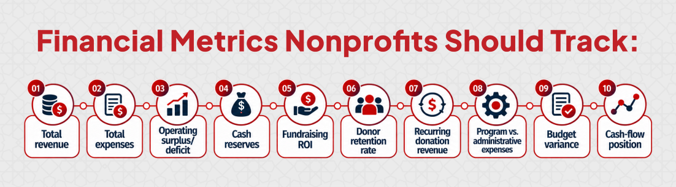
Tracking these metrics consistently, ideally through an automated dashboard rather than a manual spreadsheet, gives boards a shared, factual basis for every decision they make together.
Frequently Asked Questions
1. What is financial management for non-profit organizations?
It’s the ongoing process of budgeting, tracking funds, enforcing controls, and reporting on how a non-profit raises and spends money, ensuring resources are used responsibly and in line with its mission.
2. Why is financial management important for non-profits?
It protects financial stability, builds donor trust, supports informed decision-making, and reduces the risk of errors or misuse of funds, all of which help an organization sustain its programs long-term.
3. What financial reports should a non-profit organization prepare?
Common reports include a statement of financial position, a statement of activities, a cash-flow statement, and budget-versus-actual comparisons for leadership and the board.
4. How should non-profits manage restricted funds?
By tracking them separately from unrestricted funds, documenting donor conditions clearly, and reconciling them regularly to confirm the money is spent exactly as intended.
5. What financial tools should non-profits use?
A combination of accounting software, non-profit management platforms, donation and fundraising tools, and budgeting or reporting dashboards, chosen based on the organization’s size and needs.
6. How can non-profits improve financial transparency?
By publishing regular financial statements, using centralized digital records, maintaining strong internal controls, and giving donors visibility into how funds are used.
7. How often should a non-profit review its finances?
Most organizations benefit from monthly reviews at the staff level and quarterly reviews with the board, alongside a full annual review or audit.
8. What are the biggest financial challenges non-profits face?
Limited resources, poor record-keeping, inaccurate budgeting, weak internal controls, and manual, time-consuming tracking processes rank among the most common struggles.
Conclusion
Financial management is essential for non-profit sustainability. Careful budgeting, strong internal controls, accurate records, honest reporting, and the right technology work together to keep an organization’s promises to donors and the communities it serves. When those pieces are in place, staff and volunteers spend less time firefighting financial confusion and more time doing the work that matters; better financial management ultimately allows non-profits to protect their resources and focus more effectively on their mission.
For Masjids and Islamic organizations specifically, that means fewer spreadsheets, fewer reconciliation headaches, and far more confidence heading into every board meeting. MOHID has supported over 1,000 mosques and Islamic organizations across the U.S. and Canada for more than 14 years, processing over $750 million in donations through its cloud software, kiosks, and tap-to-pay devices.
Ready to bring clarity to your Masjid’s finances?
Let MOHID organize your donations and reports into one clear dashboard.
Related Sources